This section describes the Syntoniq keyboard's layout engine. The primary objective is to explain how to create your own layouts. We cover
Manual mappings are defined with the define_manual_mapping directive. This directive must be followed by a valid layout definition block. A layout definition block contains rows of note names, optionally followed by cycle markers (' or , optionally followed by a number). These represent a rectangular region of keys. You may use the value ~ to leave a specific key unmapped. Exactly one note (or ~) must be preceded by @. This marks it as the anchor note, which is placed in a layout using place_mapping. In the example below, the anchor note is the lower-left note, but it can be any note.
When you place keys with manual mapping, you are free to use whitespace in whatever way works best. In the example mapping shown below, we stagger the keys so they are easier to visualize on a hexagonal grid. This has no syntactic significance, and it has no effect on a rectangular grid, but it can help you to lay things out visually so it looks more like it will actually appear on a hexagonal keyboard. This is entirely optional. The Syntoniq parser does not consider spaces other than to separate notes from each other. A future version of Syntoniq may include a reformatter that can help with aligning layout definitions. (FUTURE: update this section if we write the formatter.)
define_manual_mapping(
    mapping="example"
    scale="JI"
    v_factor=3/2
    h_factor=2
) <<
EK  e'  Bh
  p   JK   F
D   C   ~
  @A  I   E
>>This is the built-in keyboard configuration. You can retrieve this by running syntoniq-kbd default-config. After the code, we will describe what's going on with some examples.
syntoniq(version=1)

define_isomorphic_mapping(mapping="12-EDO-h2v5" steps_h=2 steps_v=5)
place_mapping(layout="12-EDO-h2v5" mapping="12-EDO-h2v5" keyboard="launchpad" anchor_row=4 anchor_col=3)
place_mapping(layout="12-EDO-h2v5" mapping="12-EDO-h2v5" keyboard="hexboard" anchor_row=8 anchor_col=8)
place_mapping(layout="12-EDO-h2v5" mapping="12-EDO-h2v5" keyboard="hexboard-60" anchor_row=9 anchor_col=8)

define_isomorphic_mapping(mapping="19-EDO-h3v2" scale="19-EDO" steps_h=3 steps_v=2)
place_mapping(layout="19-EDO-h3v2" mapping="19-EDO-h3v2" keyboard="launchpad" anchor_row=4 anchor_col=3)
place_mapping(layout="19-EDO-h3v2" mapping="19-EDO-h3v2" keyboard="hexboard" anchor_row=8 anchor_col=7)
place_mapping(layout="19-EDO-h3v2" mapping="19-EDO-h3v2" keyboard="hexboard-60" anchor_row=9 anchor_col=8)

define_isomorphic_mapping(mapping="31-EDO-h5v3" scale="31-EDO" steps_h=5 steps_v=3)
place_mapping(layout="31-EDO-h5v3" mapping="31-EDO-h5v3" keyboard="launchpad" anchor_row=4 anchor_col=3)
place_mapping(layout="31-EDO-h5v3" mapping="31-EDO-h5v3" keyboard="hexboard" anchor_row=7 anchor_col=8)
place_mapping(layout="31-EDO-h5v3" mapping="31-EDO-h5v3" keyboard="hexboard-60" anchor_row=8 anchor_col=7)

define_generated_scale(scale="17-EDO" divisions=17)
define_isomorphic_mapping(mapping="17-EDO-h3v2" scale="17-EDO" steps_h=3 steps_v=2)
place_mapping(layout="17-EDO-h3v2" mapping="17-EDO-h3v2" keyboard="launchpad" anchor_row=4 anchor_col=3)
place_mapping(layout="17-EDO-h3v2" mapping="17-EDO-h3v2" keyboard="hexboard" anchor_row=8 anchor_col=7)
place_mapping(layout="17-EDO-h3v2" mapping="17-EDO-h3v2" keyboard="hexboard-60" anchor_row=9 anchor_col=8)

define_generated_scale(scale="41-EDO" divisions=41)
define_isomorphic_mapping(mapping="41-EDO-h7v3" scale="41-EDO" steps_h=7 steps_v=3)
place_mapping(layout="41-EDO-h7v3" mapping="41-EDO-h7v3" keyboard="launchpad" anchor_row=4 anchor_col=3)
place_mapping(layout="41-EDO-h7v3" mapping="41-EDO-h7v3" keyboard="hexboard" anchor_row=7 anchor_col=8)
place_mapping(layout="41-EDO-h7v3" mapping="41-EDO-h7v3" keyboard="hexboard-60" anchor_row=8 anchor_col=7)

define_generated_scale(scale="53-EDO" divisions=53)
define_isomorphic_mapping(mapping="53-EDO-h9v4" scale="53-EDO" steps_h=9 steps_v=4)
place_mapping(layout="53-EDO-h9v4" mapping="53-EDO-h9v4" keyboard="launchpad" anchor_row=4 anchor_col=3)
place_mapping(layout="53-EDO-h9v4" mapping="53-EDO-h9v4" keyboard="hexboard" anchor_row=7 anchor_col=8)
place_mapping(layout="53-EDO-h9v4" mapping="53-EDO-h9v4" keyboard="hexboard-60" anchor_row=9 anchor_col=7)

define_manual_mapping(
    mapping="JI"
    scale="JI"
    v_factor=3/2
    h_factor=2
) <<
p    F   EK    e'   Bh
  @A   I    E    D    C
>>
place_mapping(
    layout="JI"
    base_pitch=264
    keyboard="hexboard"
    mapping="JI"
    anchor_row=7
    anchor_col=5
)
place_mapping(
    layout="JI"
    base_pitch=264
    keyboard="launchpad"
    mapping="JI"
    anchor_row=3
    anchor_col=2
)
place_mapping(
    layout="JI-19-EDO"
    keyboard="launchpad"
    mapping="JI"
    anchor_row=1
    anchor_col=1
    rows_above=3
    rows_below=0
)
place_mapping(
    layout="JI-19-EDO"
    keyboard="launchpad"
    mapping="19-EDO-h3v2"
    anchor_row=6
    anchor_col=3
)
place_mapping(
    layout="JI-19-EDO"
    keyboard="hexboard"
    mapping="JI"
    anchor_row=1
    anchor_col=2
    rows_above=3
    rows_below=0
)
place_mapping(
    layout="JI-19-EDO"
    keyboard="hexboard"
    mapping="19-EDO-h3v2"
    anchor_row=9
    anchor_col=9
)

define_scale(scale="harmonics") <<
 1 h1    2 h2    3 h3    4 h4    5 h5    6 h6    7 h7    8 h8
 9 h9   10 h10  11 h11  12 h12  13 h13  14 h14  15 h15  16 h16
17 h17  18 h18  19 h19  20 h20  21 h21  22 h22  23 h23  24 h24
25 h25  26 h26  27 h27  28 h28  29 h29  30 h30  31 h31  32 h32
33 h33  34 h34  35 h35  36 h36  37 h37  38 h38  39 h39  40 h40
41 h41  42 h42  43 h43  44 h44  45 h45  46 h46  47 h47  48 h48
49 h49  50 h50  51 h51  52 h52  53 h53  54 h54  55 h55  56 h56
57 h57  58 h58  59 h59  60 h60  61 h61  62 h62  63 h63  64 h64
>>

define_manual_mapping(mapping="harmonics" scale="harmonics") <<
h57 h58 h59 h60 h61 h62 h63 h64
h49 h50 h51 h52 h53 h54 h55 h56
h41 h42 h43 h44 h45 h46 h47 h48
h33 h34 h35 h36 h37 h38 h39 h40
h25 h26 h27 h28 h29 h30 h31 h32
h17 h18 h19 h20 h21 h22 h23 h24
h9  h10 h11 h12 h13 h14 h15 h16
@h1 h2  h3  h4  h5  h6  h7  h8
>>
place_mapping(
    layout="harmonics"
    mapping="harmonics"
    base_pitch=50
    keyboard="launchpad"
    anchor_row=1
    anchor_col=1
)
place_mapping(
    layout="harmonics"
    mapping="harmonics"
    base_pitch=50
    keyboard="hexboard"
    anchor_row=4
    anchor_col=4
    rows_above=7
    rows_below=0
    cols_right=7
    cols_left=0
)

define_generated_scale(scale="13-ED3" cycle_ratio=3 divisions=13)
define_isomorphic_mapping(mapping="13-ED3-h2v3" scale="13-ED3" steps_h=2 steps_v=3)
place_mapping(layout="13-ED3-h2v3" mapping="13-ED3-h2v3" keyboard="hexboard" anchor_row=7 anchor_col=8)

define_generated_scale(scale="27-ED3" cycle_ratio=3 divisions=27)
define_isomorphic_mapping(mapping="27-ED3-h3v5" scale="27-ED3" steps_h=3 steps_v=5)
place_mapping(layout="27-ED3-h3v5" mapping="27-ED3-h3v5" keyboard="hexboard" anchor_row=7 anchor_col=8)This section is technically dense. Understanding it is not essential to using the keyboard. Feel free to skim or skip, picking up below with Other Considerations. When using the Syntoniq keyboard, the calculations are done manually. The main thing you have to understand is that manual layouts map notes in a physically rectangular region even on a hexagonal keyboard. You can develop a feel for this by playing around with defining manual layouts to see what they look like on a keyboard. This section explains it fully. We discuss
Here are a few examples of computing pitches and notes. We'll use the JI-19-EDO layout because this is the most general, including both an isomorphic and a manual mapping. If you can do this one, you can do any of them.
Some general notes, which you can verify from the keyboard configuration shown above.
JI mapping
v_factor=3/2 and h_factor=2@ before the note name)19-EDO-h3v2 mapping is an isomorphic mapping with steps_h=3 and steps_v=2, hence h3v2.Below are some walk-throughs of computing notes on the various keyboards. You can verify these using the diagrams.
Here is a diagram of the JI-19-EDO layout on the Launchpad:
Shift |
Transpose |
Sustain |
|||||||
▲ |
b, ^17|19 |
c# ^1|19 |
d# ^4|19 |
e# ^7|19 |
g% ^10|19 |
a% ^13|19 |
b% ^16|19 |
c' 1 |
|
▼ |
a#, ^15|19 |
b#, ^18|19 |
d% ^2|19 |
e% ^5|19 |
f ^8|19 |
g ^11|19 |
a ^14|19 |
b ^17|19 |
|
Reset |
a%, ^13|19 |
b%, ^16|19 |
c 1 |
d ^3|19 |
e ^6|19 |
f# ^9|19 |
g# ^12|19 |
a# ^15|19 |
|
g, ^11|19 |
a, ^14|19 |
b, ^17|19 |
c# ^1|19 |
d# ^4|19 |
e# ^7|19 |
g% ^10|19 |
a% ^13|19 |
||
p↑ 45/32 |
F↑ 9/5 |
EK↑ 33/32 |
e'↑ 6/5 |
Bh↑ 21/16 |
p↑→ 45/32 |
F↑→ 9/5 |
EK↑→ 33/32 |
||
A↑ 3/2 |
I↑ 27/16 |
E↑ 15/8 |
D↑ 1 |
C↑ 9/8 |
A↑→ 3/2 |
I↑→ 27/16 |
E↑→ 15/8 |
||
p 15/8 |
F 6/5 |
EK 11/8 |
e' 8/5 |
Bh 7/4 |
p→ 15/8 |
F→ 6/5 |
EK→ 11/8 |
||
Show Notes |
A 1 |
I 9/8 |
E 5/4 |
D 4/3 |
C 3/2 |
A→ 1 |
I→ 9/8 |
E→ 5/4 |
Scroll layouts |
1 |
2 |
3 |
4 |
5 |
6 |
7 |
8 |
||
On the Launchpad:
place_mapping for JI-19-EDO with keyboard="launchpad" places the JI mapping with its anchor at row=1, col=1, and specifies rows_above=3, and rows_below=0. That means all columns (infinite in both directions) and rows 1 (anchor row: 1 - rows below: 0) through 4 (anchor row: 1 + rows above: 3), inclusive, are claimed by that mapping. Since row 7 is not between 1 and 4 inclusive, it doesn't belong to that mapping.19-EDO-h3v2 with its anchor at row=6, col=3. That means row 7, column 5 is one row above and two columns to the right of the anchor. That means its scale degree is $1\times 2$ (from one row above) $+ 2 \times 3$ (from two columns to the right), which is 8, so its base pitch should be ^8|19. Consulting the built-in scales, that would have the note name f.JI.c'.I.I↑→.I is 9/8, the horizontal tile factor is 2, and the vertical tile factor is 3/2, this notes relative pitch is 27/8.27/8 to within the cycle (which is 2, an octave) brings us to 27/16, so this is note I↑→ with pitch 27/18.Here is a diagram of the JI-19-EDO layout on the HexBoard:
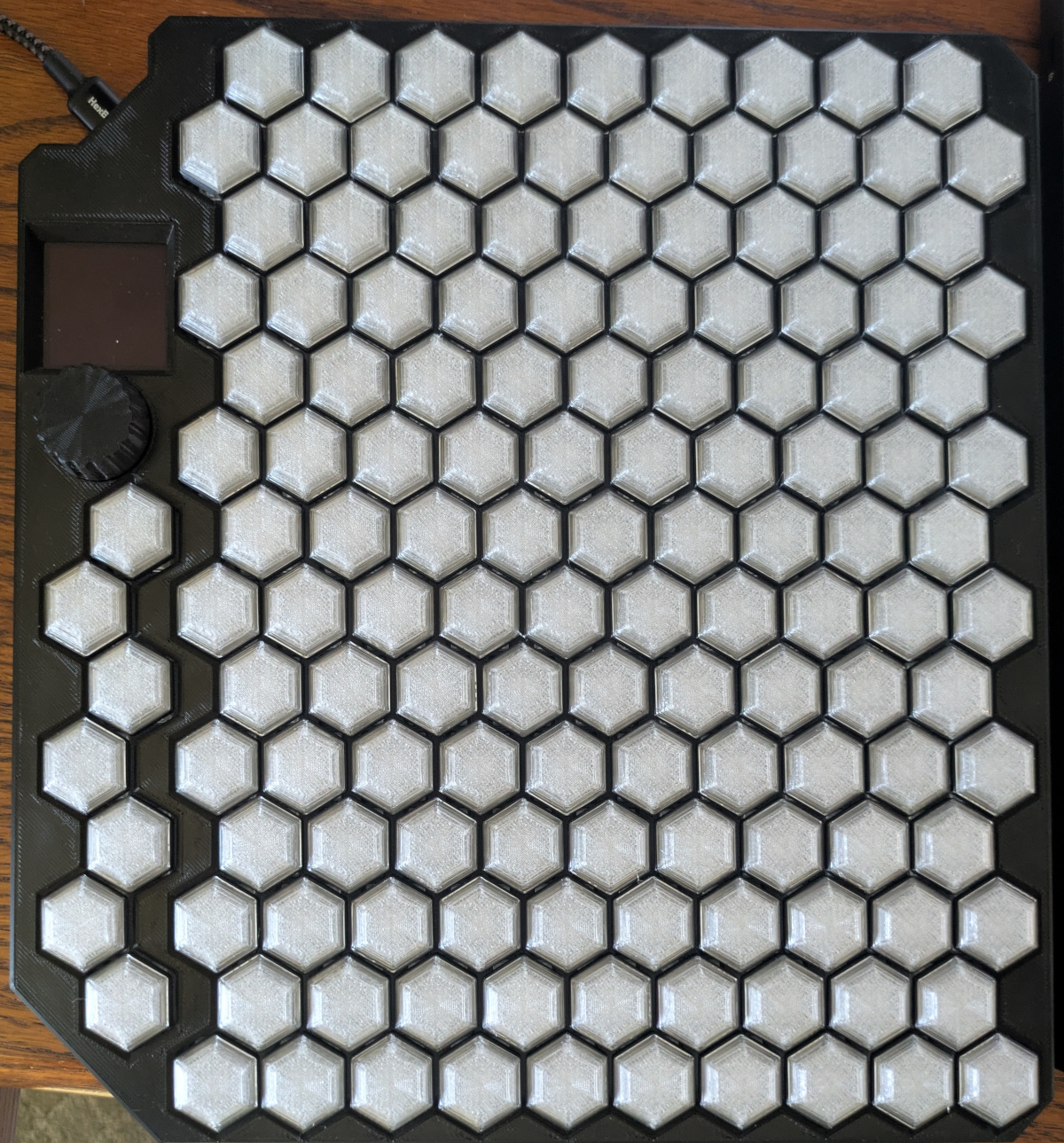
Before we can work with this using the HexBoard, we have to introduce the concept of stagger. As discussed above, the up direction on a hexagonal keyboard is up and to the left. This is fine with isomorphic layouts, but with manual layouts, we always define a group of keys in a rectangular layout and tile them rectangularly. We effectively have a rectangular grid of groups of hexagonal keys. For this reason, we stagger columns for purposes of finding notes in a manual layout. Specifically, we take the Euclidean quotient of the number of rows above the anchor row and 2 and subtract that from the column. The Euclidean quotient is the integer part of the result of Euclidean division, which takes a quotient and a remainder that is always between 0 and the denominator. For positive numbers, it's the same as integer division. For negative numbers, you move toward negative infinity rather than toward 0. This is usually written as $\lfloor \frac{a}{b}$\rfloor$. This "corrects" for the columns drifting to the right. Because of stagger, you will have the best results for manual layouts if you ensure they are an even number of rows high. Note that you can leave some keys in a manual mapping blank by using the note ~ in a given spot.
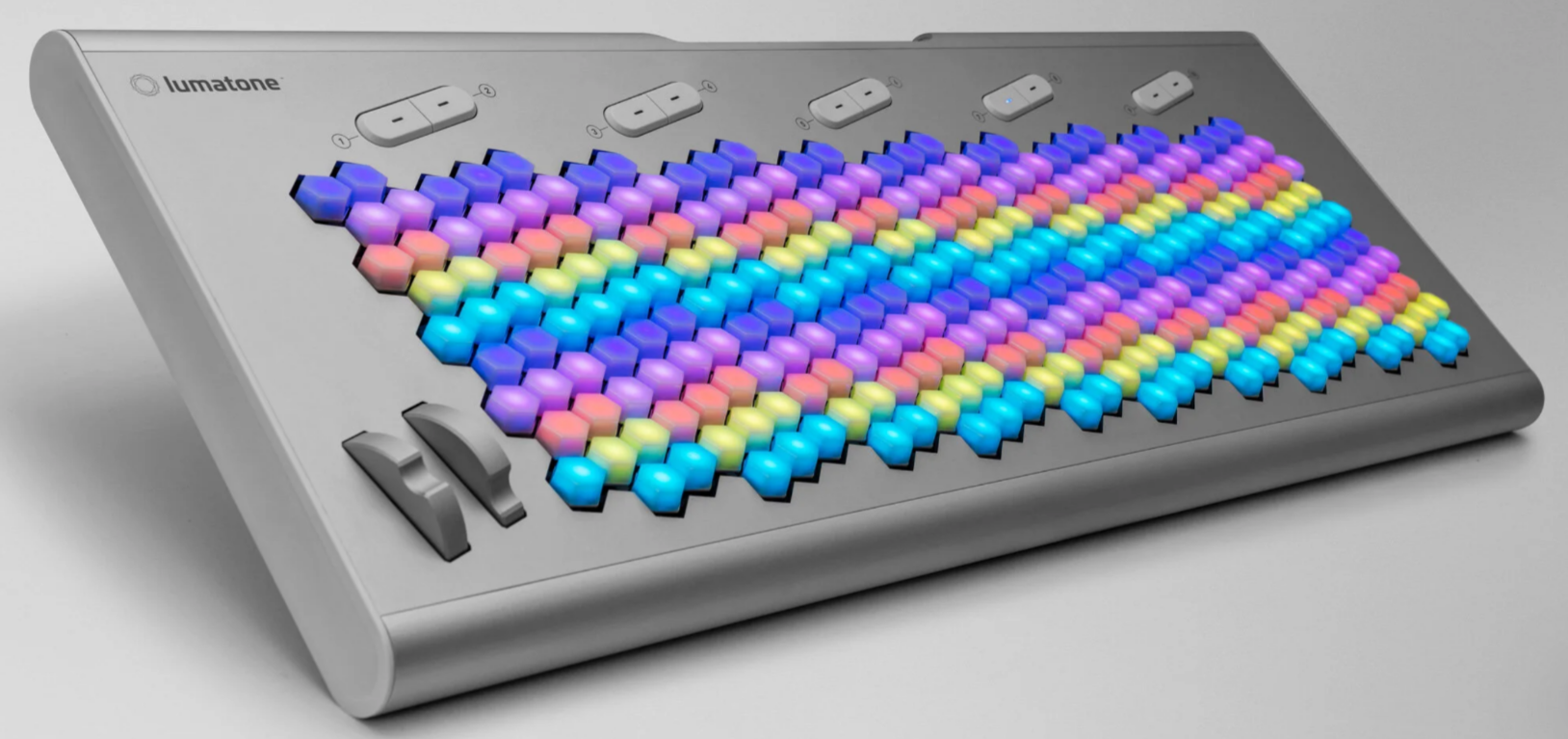
To make it concrete, observe that the note A appears in the above diagram on row 1, column 2. Two physical, rectangular rows above that, meaning two rows above in the 90° vertical direction, not the up and left direction, we would want to find the note A↑ because we want manual layout tiling to be vertical, not skewed to the left. You can see A↑ in that spot on the keyboard. It would be easier if the vertical neighbor two rows above row 1, column 2 were row 3, column 2, but it's not: it's row 1, column 3 because of the up/left direction of column numbering. To account for this, we introduce the concept of stagger. The stagger here is 1 ($\lfloor \frac{3-1}{2} \rfloor = 1$), which means we want to place all notes one column to the right over where they would land if we just added to the row. In other words, if we look at row 3, column 3, we should find the note that is two rows above row 1, column 2, which is $3 - 1$. That means we need to subtract the stagger amount from the column on the keyboard to get the column to search in the mapping. It's a bit much, but you can convince yourself by counting it out. If we didn't have stagger, manual mappings taller than two rows would be shaped like parallelograms, and we would tile that way as well. This doesn't work very well when you have a physically rectangular keyboard with hexagonal keys! This scheme works perfectly with the HexBoard, but it would work with larger, more complex hexagonal keyboards (like the Lumatone) as well.
place_mapping for JI-19-EDO with keyboard="hexboard" places the JI mapping with its anchor at row=1, col=2, and specifies rows_above=3, and rows_below=0. That means all columns (infinite in both directions) and rows 1 (anchor row: 1 - rows below: 0) through 4 (anchor row: 1 + rows above: 3), inclusive, are claimed by that mapping. Since row 7 is not between 1 and 4 inclusive, it doesn't belong to that mapping.19-EDO-h3v2 with its anchor at row=9, col=9. That means row 7, column 6 is one row below and three columns to the left of the anchor. That means its scale degree is $-2\times 2$ (from two rows below) $+ -3 \times 3$ (from three columns to the left), which is $-13$. We add 19 to get this in the range from 0 to 18, meaning that this is degree 6 one octave below. It's base pitch should be ^6|19. Consulting the built-in scales, that would have the note name e, so our final note is e, with scale degree ^6|19.EK.E is 5/4 and K is 11/10, which makes EK 11/8. Our final note is EK↑→ with a base-relative pitch of 11/8.An isomorphic layout will always repeat. If you go to the right by the steps_v amount and down by the steps_h amount (or, equivalently, up by steps_v and to the left by steps_h) you will always land back at the same note because you are computing $(h \times v) + (h \times -v)$.
There is no guarantee that you will cover all the notes. To cover all the notes, at least one of the following must be true:
steps_v have no common factorssteps_h have no common factorssteps_v and steps_h have no common factorsThis is just modular arithmetic, so I won't "prove" that this is true here, but you can count it out and see that it's true. For example, if you had a 12-EDO with steps_h=2 and steps_v=4, you would find repeating patterns, but you would only be able to reach the even steps. For very large EDOs, you can use this intentionally. For example, one way to create a 72-EDO layout would be to use step sizes steps_h=4, steps_v=10, which would give you only the even keys (since $2$ is the greatest common factor of 4, 10, and 72). You could then have a separate mapping covering part of the keyboard (maybe just one row or even just part of one row) that had steps_h=1. You could use that row as a transposition bar when building chords. This would make it cumbersome to play arbitrary 72-EDO intervals, but you could construct chords with sustain mode by adding the even notes, transposing, and adding the odd notes. A similar trick could work with 106-EDO by creating offsets that only cover the even notes and using a single-step 106-EDO transposition bar.
An isomorphic mapping works best with even divisions of an interval. This is the only way you get the exact same interval with the same relative position. Syntoniq does not enforce this: you are free to create scales with uneven divisions (such as any just intonation scale) and use an isomorphic layout with it. Notes are assigned to keys based on scale degree, not based on pitch. This might be useful in some cases, such as if you are intentionally playing with out-of-tune intervals in just intonation or if you are using some other uneven arrangement and want the convenience of not manually laying out the notes and are willing to tolerate that chord shapes will not be truly isomorphic.
Let's wrap up with an interesting scale: 27-ED3. This is 27 divisions of the tritave, ratio 3, which is an octave and a just intonation perfect fifth. This is the third harmonic. Some scales, such as Bohlen-Pierce (13-ED3), are based on the tritave. Below is a diagram of 27-ED3 on the HexBoard.
Here are several things to notice:
B, which has the ratio 2/1. This is an octave over A. We don't see B by itself in an octave-based scale as the octave would just be A', but here, A' would be three times the frequency of A. The pitch of B is 3^17|27, which is $3^{\frac{17}{27}}$, which is 1.997145, or 1,197¢. This is only 3¢ below 1,200, which puts is close enough to the octave to color the note yellow. This signals that we have a close octave in this tritave-based tuning.